Easy Homemade Mille Feuille with Light Vanilla Cream (Healthier Recipe)
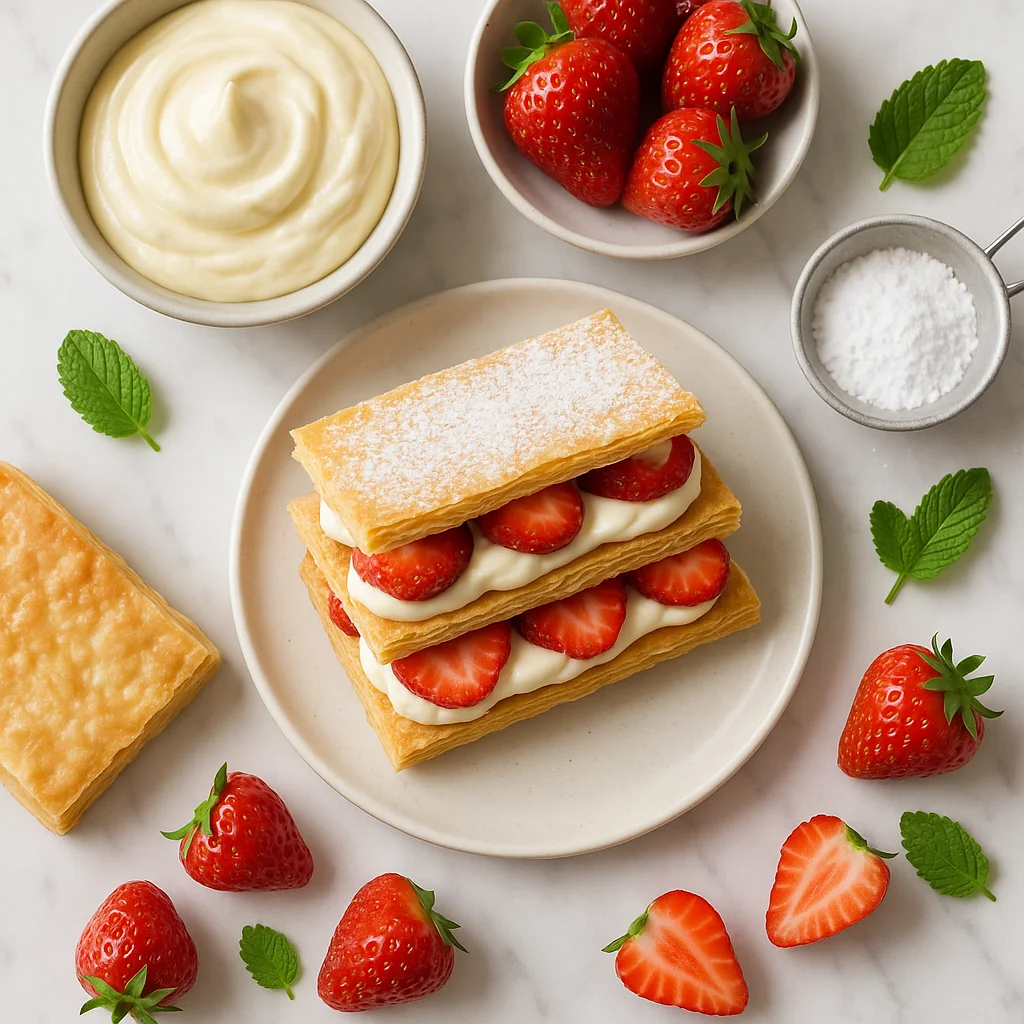
Mille-feuille means a thousand leaves. The name refers to the hundreds of thin, flaky layers you get when butter is folded repeatedly into pastry dough, creating a structure that shatters dramatically when you press a fork through it. Most home bakers assume it is impossible to achieve this without professional skills or a laminated dough made from scratch over two days. Ready-made all-butter puff pastry, baked until properly golden and shatteringly crisp, produces results remarkably close to the real thing. This lighter version uses a vanilla cream made with Greek yogurt and a small amount of whipped cream rather than a full pastry cream, which cuts the richness while keeping the filling set and sliceable.
Why this recipe works
The key to mille-feuille is texture contrast. You need pastry that is genuinely crisp and a filling that is genuinely set. A filling that is too soft will squeeze out the sides when you cut through the layers. Greek yogurt mixed with whipped cream sets firmly enough to hold its shape when cut, while being lighter and more refreshing than a traditional creme patissiere made with egg yolks and butter. A small amount of maple syrup sweetens the cream without the overly sweet quality you get from icing sugar.
Getting it right
Bake the puff pastry sheets weighted down. Lay a sheet of baking parchment on top and place another baking tray on top of that. This compresses the layers slightly and prevents them from puffing unevenly, creating flat, even sheets that are easier to layer and cut.
Chill the assembled mille-feuille for at least an hour before serving. The chilling firms the cream and makes the whole construction much easier to slice cleanly.
Common mistakes
Not baking the pastry long enough produces pale, soft layers that go soggy quickly when the filling is added. The pastry should be a deep, even golden brown all the way through.
Cutting with a sawing motion rather than a single downward press causes the layers to slide apart. Use a sharp serrated knife and press straight down in one confident motion.
Substitutions
Coconut whipped cream can replace the dairy cream for a lighter, dairy-free filling. A chocolate version is achieved by stirring a tablespoon of raw cacao powder into the cream filling. Fresh raspberries layered with the cream add tartness that cuts through the richness of the pastry beautifully.
Serving suggestion
Dust the top with a fine layer of icing sugar through a sieve immediately before serving. Add fresh berries alongside for colour. Serve within two hours of assembling for the crispest pastry layers.
Ingredients
- 200 g wholemeal spelt flour (plus extra for dusting)
- 1 tsp flaky sea salt
- 130 g unsalted butter (cold, cut into small cubes)
- 80 ml ice cold water (add a tablespoon at a time)
- 1 tsp white wine vinegar (helps relax the gluten for easier rolling)
- 300 g full-fat Greek yogurt (strained overnight for a thicker set)
- 180 ml semi-skimmed milk
- 2 tbsp cornflour (also called cornstarch)
- 2 tbsp raw honey (or pure maple syrup for a different flavour)
- 1 tsp vanilla bean paste (not extract, for a stronger flavour)
- 1 large egg yolk (for the milk-based custard base only)
- 1 tbsp icing sugar (for dusting the top, optional)
- 80 g fresh raspberries (to serve, adds colour and antioxidants)
Instructions
- 1
Make the rough puff pastry. Add the wholemeal spelt flour and sea salt to a large bowl and stir briefly. Tip in the cold butter cubes and toss them through the flour. Using your fingertips, press the butter pieces flat but do not rub them in fully. You want visible chunks of butter remaining, around the size of a small pea or larger. This creates the layers.
Keep everything cold. If the butter starts to soften at any point, pop the bowl in the fridge for 10 minutes before continuing.
- 2
Stir the white wine vinegar into the ice cold water. Pour it gradually over the flour and butter mixture, stirring with a butter knife or silicone spatula after each addition. Stop adding water as soon as the dough just comes together. It will look a little shaggy and rough. That is exactly right.
Do not knead. Overworking spelt dough makes it tough because spelt gluten is more fragile than wheat gluten.
- 3
Tip the dough onto a lightly floured surface and gently shape it into a rough rectangle. Roll it out to roughly 40cm by 15cm. Fold the bottom third up and the top third down, like a letter. Rotate 90 degrees and roll out again. Repeat this fold and roll process 3 times in total, then wrap the dough in cling film and refrigerate for 30 minutes.
Dust the surface lightly between rolls to prevent sticking, but avoid adding too much extra flour as it can toughen the pastry.
- 4
While the pastry chills, make the vanilla filling. Whisk the cornflour and egg yolk together in a small bowl until smooth. Warm the milk gently in a small saucepan over medium-low heat with the honey and vanilla bean paste, stirring until the honey dissolves. Do not let it boil. Pour a ladleful of the warm milk slowly over the egg yolk mixture while whisking constantly, then pour everything back into the pan.
Adding the hot milk slowly to the yolk first is called tempering. It stops the egg from scrambling.
- 5
Stir the custard base constantly over medium-low heat for 3 to 4 minutes until it thickens enough to coat the back of a spoon. Remove from the heat, press cling film directly onto the surface to prevent a skin forming, and cool completely in the fridge for at least 30 minutes.
- 6
Once the custard base is fully cold, whisk the strained Greek yogurt into it until completely smooth and combined. The filling should be thick, creamy and hold its shape when spooned. Return it to the fridge while you bake the pastry.
If your filling looks a little thin, stir in a small extra spoonful of strained yogurt and chill for another 10 minutes.
- 7
Preheat your oven to 200 degrees Celsius (180 fan, 400 Fahrenheit). Remove the chilled pastry from the fridge and roll it out on a lightly floured surface to roughly 3mm thickness. Cut it into 3 equal rectangles of the same size, approximately 22cm by 12cm each. Place them on two baking sheets lined with parchment paper.
Prick all over with a fork before baking. This controls how much the pastry puffs, keeping layers flat and even for easy stacking.
- 8
Place a second sheet of parchment on top of each pastry rectangle and weigh it down with another baking tray. This technique keeps the pastry flat rather than puffing unevenly. Bake for 18 to 22 minutes until deep golden and completely crisp. Remove the top trays and parchment for the final 4 minutes to let the surface colour. Cool completely on a wire rack.
The pastry must be completely cool before you assemble. Warm pastry will cause the cream to melt and the whole thing will slide apart.
- 9
Assemble the mille feuille. Place one pastry rectangle on your serving board. Spoon or pipe half the vanilla cream evenly across it. Lay a second pastry rectangle gently on top and press down very slightly. Spread or pipe the remaining cream over this layer. Top with the final pastry rectangle.
A piping bag fitted with a round nozzle gives a cleaner, more even cream layer and makes slicing much neater.
- 10
Refrigerate the assembled mille feuille for at least 20 minutes to allow the layers to set and firm up. When ready to serve, dust the top lightly with icing sugar and arrange fresh raspberries on top. Use a serrated knife and a gentle sawing motion to cut into 6 individual slices cleanly.
Wipe the knife clean between each cut for the neatest slices that show off all the layers properly.
Nutrition per serving
274kcal
Calories
8g
Protein
28g
Carbs
14g
Fat
3g
Fibre
9g
Sugar
110mg
Sodium
Pro Tips
- ✓
Strain your Greek yogurt overnight through a muslin cloth or fine sieve lined with kitchen paper to remove excess liquid. This makes the filling much thicker and more stable.
- ✓
Cold butter is non-negotiable for the pastry. If your kitchen is warm, cube the butter and freeze it for 15 minutes before you start.
- ✓
Roll the pastry in one direction first, then rotate, rather than pushing the rolling pin back and forth. This keeps the layers more even.
- ✓
Assemble no more than 2 hours before serving. The pastry begins to soften once in contact with the filling for an extended time.
- ✓
For cleaner cuts, chill the assembled mille feuille for 30 minutes and use a sharp serrated bread knife with slow, gentle sawing strokes.
- ✓
Taste your filling before assembling. If you prefer it sweeter, add an extra half teaspoon of honey and stir well before refrigerating.
Frequently Asked Questions
Variations
- •
Dark Chocolate Drizzle Mille Feuille
Melt 40g of good quality dark chocolate (70 percent cocoa or higher) and drizzle it over the top pastry layer before chilling. The bitterness of the dark chocolate balances beautifully with the lighter vanilla cream and adds a small dose of antioxidants and magnesium.
- •
Strawberry and Basil Mille Feuille
Add a single layer of thinly sliced fresh strawberries between the cream and each pastry layer. Stir two finely chopped fresh basil leaves into the filling for a subtle herbal lift. This works beautifully in summer and makes the dessert feel even fresher and lighter.
- •
Lemon Curd Swirl Mille Feuille
Stir 2 tablespoons of good quality lemon curd through the finished vanilla yogurt filling before assembling. The tartness cuts through the cream and brightens the whole dessert. Top with a few thin strips of candied lemon zest for a restaurant-quality finish.
- •
Spiced Chai Mille Feuille
Add a quarter teaspoon each of ground cardamom and ground cinnamon and a pinch of ground ginger to the milk while warming it for the custard base. The warm chai-inspired spices give the filling a cosy, aromatic depth that is particularly lovely in autumn and winter.
Substitutions
- •Wholemeal spelt flour → Wholemeal plain wheat flour (Works well though the texture will be slightly denser. You can also use a 50/50 mix of plain white flour and wholemeal for a lighter result with more fibre than an all-white pastry.)
- •Raw honey → Pure maple syrup (Use the same quantity. Maple syrup has a slightly lower glycaemic index than honey and gives a gentle caramel note to the filling that works very nicely with vanilla.)
- •Greek yogurt → Quark or fromage frais (Both give a similarly thick, creamy and tangy filling. Quark is particularly high in protein and very low in fat, making it an even lighter option. Strain it if it seems watery.)
- •Semi-skimmed milk → Oat milk (Oat milk works well in the custard base and has a natural sweetness that complements the honey. Use an unsweetened barista version for the best consistency when heating.)
- •Vanilla bean paste → Seeds from one vanilla pod (Scraping a fresh vanilla pod gives an even more intense flavour with beautiful black specks through the cream. Split the pod, scrape the seeds and add them directly to the milk as it warms.)
🧊 Storage
Store any leftover assembled mille feuille in an airtight container in the fridge for up to 24 hours. The pastry will begin to soften after this point as it absorbs moisture from the cream. Unassembled pastry layers can be stored in an airtight container at room temperature for up to 2 days. The filling keeps refrigerated for up to 3 days.
📅 Make Ahead
The rough puff pastry dough can be made and refrigerated up to 48 hours in advance, or frozen for up to 4 weeks. Baked pastry sheets can be made a day ahead and stored in an airtight container at room temperature. The vanilla yogurt filling can be made up to 2 days ahead and kept covered in the fridge. Assemble within 2 hours of serving for the crispest result.
More French Desserts Recipes

Healthy Palmiers Recipe: Puff Pastry French Cookies with Coconut Sugar and Cinnamon
Easy Homemade French Macarons Recipe (Lighter and Naturally Sweetened)
Healthy French Madeleine Cookies Recipe Classic Style with Almond Flour