No-Bake Sugar Free Strawberry Cheesecake with Almond Oat Crust
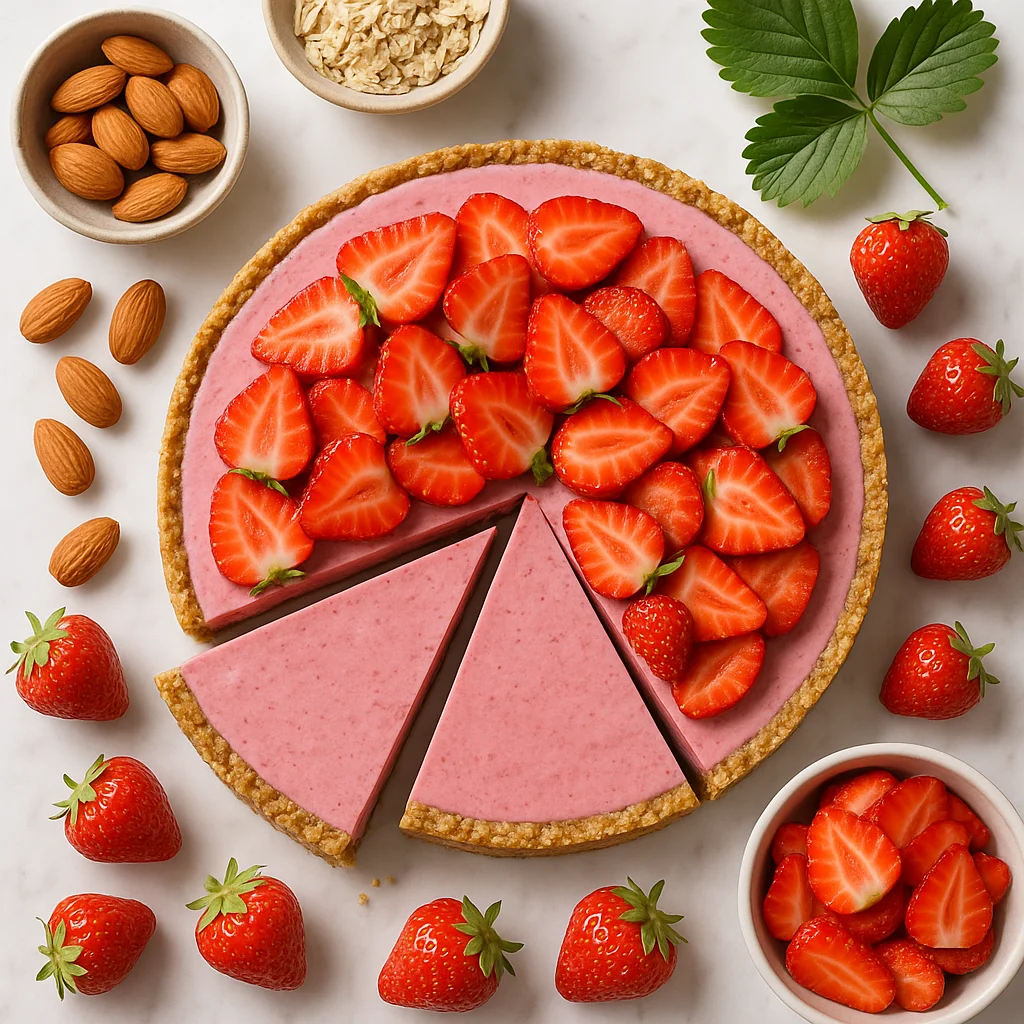
If you have been searching for a truly indulgent yet genuinely healthy dessert, this no-bake sugar free strawberry cheesecake is exactly what your recipe collection has been missing. Made without a single gram of refined sugar, sweetened naturally with erythritol and the bright flavour of fresh strawberries, and built on a wholesome almond and oat crust, this cheesecake delivers everything you love about the classic dessert with a nutritional profile you can actually feel good about. Whether you are managing blood sugar levels, following a low-carb lifestyle, catering for a diabetic family member, or simply trying to reduce your daily sugar intake without sacrificing dessert, this recipe was created with you in mind.
The beauty of this cheesecake lies in its simplicity. There is no oven involved, no complicated baking technique, and no specialist equipment beyond a standard springform tin and a hand mixer. You simply press the crust into your tin, whip up the creamy filling, pour over your strawberry layer, and let the refrigerator do all the hard work. The result is a silky, set cheesecake with a gorgeous pink strawberry topping that looks impressive enough for a dinner party but is easy enough for a weeknight treat.
What makes this recipe genuinely healthier than traditional cheesecake? First, the base. Instead of a butter-drenched biscuit crust loaded with refined flour and sugar, we use a combination of ground almonds and rolled oats bound with a small amount of coconut oil and a touch of erythritol. This swap significantly increases the fibre content of each slice and reduces the overall calorie load. Ground almonds provide healthy monounsaturated fats, vitamin E, and a satisfying nuttiness that pairs beautifully with strawberries. Rolled oats add soluble fibre, which can help support healthy cholesterol levels and keep you feeling full for longer.
The filling uses full-fat cream cheese for richness and structure, but the quantity has been carefully balanced with thick Greek yoghurt, which adds protein, reduces overall fat, and gives the filling a pleasantly light texture without compromising on creaminess. One key detail that separates a smooth, professional-tasting filling from a gritty one: always use powdered erythritol rather than granulated. Granulated erythritol will not dissolve fully in a no-bake, unheated filling, and the result is an unpleasant sandy texture that undermines an otherwise excellent cheesecake. A splash of fresh lemon juice and lemon zest round out the flavour beautifully, the acidity brightens the sweetness and gives the filling that classic tangy cheesecake character.
The strawberry topping is where this recipe truly shines. Fresh strawberries are gently simmered with a touch of erythritol and agar agar powder, a plant-based setting agent derived from seaweed, to create a vibrant, jewel-red compote that sets beautifully over the cream cheese filling. Unlike gelatin, agar agar is entirely vegan-friendly and sets firmer, meaning your cheesecake slices cleanly every time. One important note: agar agar must be boiled to activate fully, so always bring the strawberry mixture to a brief simmer after stirring in the dissolved agar agar. If you skip this step, the topping may not set correctly.
Each slice of this sugar free strawberry cheesecake comes in at around 195 calories, with 5 grams of fibre, less than 4 grams of naturally occurring sugar from the fruit, and a solid hit of protein from the Greek yoghurt and cream cheese combination. Compare that to a traditional strawberry cheesecake slice which can easily clock in at 450 to 550 calories with 30 or more grams of sugar, and the difference is striking.
This recipe is naturally gluten-free if you use certified gluten-free oats, making it a wonderful option for those with gluten sensitivity or coeliac disease. It is refined sugar free, lower in carbohydrates than traditional cheesecake, and suitable for most low-carb and diabetic-friendly eating plans. You can prepare it a full day ahead of serving, in fact, the flavour and texture actively improve with an overnight rest in the refrigerator, as the crust firms up and the filling becomes more cohesive and flavoursome.
If you are looking for variations, this base recipe is wonderfully versatile. Swap the strawberries for raspberries or blueberries, add a layer of unsweetened cocoa powder to the filling for a chocolate twist, or make individual mini versions in a lined muffin tin for perfectly portioned party treats. Once you make this no-bake sugar free strawberry cheesecake, we are confident it will become a permanent fixture in your healthy dessert rotation.
Ingredients
- 120 g ground almonds (also called almond flour; blanched almond flour gives the smoothest texture but natural ground almonds work equally well)
- 60 g rolled oats (use certified gluten-free oats if needed; do not substitute instant oats as they will make the crust too soft)
- 3 tbsp coconut oil (melted and cooled to room temperature; refined coconut oil has a neutral flavour if you prefer no coconut taste)
- 2 tbsp powdered erythritol (for the crust; granulated erythritol also works here as the crust is not eaten raw and texture is less critical)
- 1 pinch fine sea salt (enhances the sweetness of the crust and balances the richness of the filling)
- 450 g full-fat cream cheese (must be softened to true room temperature — leave out for at least 1 hour; do not use low-fat cream cheese as the filling will not set as firmly)
- 200 g plain full-fat Greek yoghurt (at room temperature; use a thick, strained variety with at least 10% fat for the best structure and creaminess)
- 80 g powdered erythritol (for the filling — must be powdered not granulated; granulated erythritol will not dissolve in a cold filling and will leave a gritty texture)
- 1 tsp pure vanilla extract (use pure extract rather than vanilla essence for the cleanest flavour)
- 2 tbsp fresh lemon juice (adds brightness and mimics the classic tang of traditional cheesecake; freshly squeezed is noticeably better than bottled)
- 1 tsp lemon zest (optional but strongly recommended — adds a fragrant citrus note that lifts the entire filling)
- 350 g fresh strawberries (hulled and roughly chopped for the topping; choose ripe, fragrant strawberries for the best colour and flavour in the compote)
- 2 tbsp powdered erythritol (for the strawberry topping; adjust to taste depending on the natural sweetness of your strawberries)
- 1 tsp agar agar powder (use powder not flakes — flakes are much weaker and require roughly three times the quantity; agar agar must be boiled to activate properly)
- 3 tbsp water (cold water for dissolving the agar agar before adding to the hot strawberry compote)
- 150 g fresh strawberries (thinly sliced for decoration; add just before serving as sliced strawberries oxidise and release liquid if left on the cheesecake too long)
Instructions
- 1
Line the base of an 8-inch springform tin with baking paper and lightly grease the sides with a little coconut oil. Set aside. Add the ground almonds and rolled oats to a food processor and pulse briefly until the oats are partly broken down but still have some texture — about 10 to 12 short pulses. Transfer to a mixing bowl.
Do not over-process the oats into a fine powder. A little texture in the crust gives it a better bite and a more satisfying crunch. Ten to twelve short pulses is enough — you still want to see some oat flakes.
- 2
Add the melted coconut oil, 2 tablespoons of powdered erythritol, and the pinch of sea salt to the almond and oat mixture. Stir well until everything is evenly combined and the mixture resembles damp sand that holds together when pressed between your fingers.
If your mixture feels too dry to press, add an extra half tablespoon of melted coconut oil. If it feels too wet or greasy, add a tablespoon of extra ground almonds. The mixture should clump easily when pressed between your fingers.
- 3
Tip the crust mixture into the prepared springform tin and use the back of a flat-bottomed glass or a measuring cup to press it firmly and evenly across the base. You want a compact, even layer with no gaps. Place the tin in the freezer for 15 minutes while you prepare the filling.
Pressing the crust firmly and evenly is the most important step for clean slices later. A flat-bottomed glass or measuring cup is ideal — press from the centre outward and use your fingers to neaten the edges. An uneven crust will crack unevenly when sliced.
- 4
In a large mixing bowl, beat the softened cream cheese with a hand mixer on medium speed for about 2 minutes until smooth and fluffy with no lumps. Add the Greek yoghurt, sifted powdered erythritol, vanilla extract, lemon juice, and lemon zest. Beat again on medium speed for another 2 minutes until the filling is completely smooth, creamy, and well combined.
Make sure your cream cheese and Greek yoghurt are genuinely at room temperature before mixing — this is the single most important step for a lump-free filling. Cold cream cheese will leave small lumps that cannot be beaten out. If short on time, unwrap the cream cheese and microwave on medium power for 15 seconds.
- 5
Remove the tin from the freezer and pour the cream cheese filling over the chilled crust. Use a spatula to spread it into an even layer, smoothing the top as much as possible. Return the tin to the refrigerator and chill for at least 1 hour, or until the filling feels just set to the touch.
Chilling the filling before adding the strawberry topping prevents the warm compote from sinking into or melting the cream cheese layer. If the filling still seems very soft after an hour, return it to the refrigerator for another 30 minutes before proceeding.
- 6
While the filling chills, prepare the strawberry topping. Place the 350g of chopped fresh strawberries and 2 tablespoons of powdered erythritol into a small saucepan over medium-low heat. Stir gently and cook for 5 to 6 minutes until the strawberries have softened and released their juices. In a small bowl, whisk the agar agar powder into 3 tablespoons of cold water until dissolved, then stir this mixture into the hot strawberry compote. Raise the heat slightly and stir constantly for 2 minutes until the agar agar is fully activated. Remove from heat and allow to cool for 8 to 10 minutes, stirring occasionally, until the compote is warm but no longer hot.
Do not let the strawberry topping cool completely before pouring it over the cheesecake — agar agar begins to set at around 35 to 40 degrees Celsius, so if the compote cools too much it will start to gel in the saucepan. Warm but not hot is the ideal pouring temperature. If it sets too soon, gently reheat it over low heat while stirring.
- 7
Carefully spoon the warm strawberry compote over the chilled cream cheese filling, spreading it gently to the edges with the back of a spoon. Work quickly but gently so you do not disturb the filling underneath. Return the cheesecake to the refrigerator and chill for a minimum of 3 hours, or ideally overnight, until completely set.
For the cleanest slices, chill the cheesecake overnight. Agar agar sets firmly enough to slice neatly after 3 hours but both the flavour and texture improve significantly with a longer overnight chill — the crust firms up and the filling becomes more cohesive.
- 8
When ready to serve, run a thin knife around the inside edge of the springform tin before releasing the clasp. Carefully lift away the sides. Arrange the thinly sliced fresh strawberries decoratively on top of the cheesecake. Slice with a sharp knife, wiping the blade clean between each cut for neat portions. Serve immediately.
For the neatest, most professional slices, dip your knife in a jug of very hot water and wipe it completely dry before each cut. This prevents the strawberry layer from dragging and gives you clean, defined portions every time. If the cheesecake base sticks to the tin base, slide a thin palette knife or fish slice gently underneath before transferring to a serving plate.
Nutrition per serving
195kcal
Calories
6g
Protein
11g
Carbs
15g
Fat
5g
Fibre
4g
Sugar
145mg
Sodium
Pro Tips
- ✓
Always use powdered erythritol rather than granulated in the cream cheese filling. Granulated erythritol will not dissolve properly in an unheated filling and leaves a noticeably gritty, sandy texture. If you can only find granulated erythritol, blitz it in a blender for 30 seconds to make your own powdered version.
- ✓
For the cleanest, most professional-looking slices, dip your knife in a jug of very hot water and wipe it completely dry before each cut. This prevents the strawberry compote layer from tearing and dragging across the surface of the filling.
- ✓
If fresh strawberries are not in season, frozen strawberries work excellently for the cooked compote topping. Thaw them fully and drain away any excess liquid before simmering, too much water in the compote can prevent the agar agar from setting correctly. Use fresh strawberries for the decoration if possible.
- ✓
This cheesecake tastes best served straight from the refrigerator rather than at room temperature. Cold temperatures keep the filling firm, the flavours brighter, and the texture more satisfying. If left at room temperature for longer than an hour, the filling will begin to soften.
- ✓
Agar agar must be boiled briefly to activate its setting properties, simply dissolving it in warm water is not enough. Make sure you bring the strawberry compote back to a gentle simmer for at least 2 minutes after adding the dissolved agar agar mixture. Under-activated agar agar will produce a topping that barely sets or remains syrupy.
- ✓
This cheesecake is an excellent candidate for making ahead. Prepare it the night before you plan to serve it, the overnight chill allows the crust to firm up, the filling to fully set, and all the flavours to meld and deepen. Simply add the fresh strawberry decoration in the morning before serving.
Frequently Asked Questions
Variations
- •
Chocolate Strawberry Cheesecake
Add 2 tablespoons of good-quality unsweetened cocoa powder to the cream cheese filling and reduce the erythritol by a teaspoon to balance the bitterness. The chocolate and strawberry combination is a classic pairing that works beautifully with this recipe.
- •
Lemon Strawberry Cheesecake
Double the lemon zest in the filling and add an extra tablespoon of lemon juice for a more pronounced citrus flavour. Replace half the strawberry topping with a layer of lemon curd made with erythritol for a tangy, vibrant dessert.
- •
Vegan Sugar Free Strawberry Cheesecake
Replace the cream cheese with a good-quality plain vegan cream cheese made from cashews or oat base, and swap the Greek yoghurt for a thick coconut yoghurt. The agar agar is already vegan, so no changes are needed to the topping. Ensure your erythritol brand is vegan certified.
- •
Mini Individual Cheesecakes
Press the crust mixture into the bases of a 12-hole muffin tin lined with paper cases. Divide the filling and topping evenly between the cases. Chill for 2 hours. These individual portions are perfect for parties, lunchboxes, or portion-controlled snacking.
Substitutions
- •Cream cheese → Vegan cream cheese (Use a cashew-based or oat-based vegan cream cheese for a fully plant-based version. The texture may be slightly softer so chill for an extra hour.)
- •Greek yoghurt → Coconut yoghurt (Full-fat coconut yoghurt works well and keeps the recipe dairy free. Choose a thick, strained variety for the best texture.)
- •Coconut oil → Unsalted butter (Melted unsalted butter can replace coconut oil in the crust in a 1:1 ratio if you prefer the flavour. This will make the recipe non-dairy-free.)
- •Ground almonds → Sunflower seed flour (For a nut-free version, replace ground almonds with sunflower seed flour in the same quantity. The crust will be slightly darker in colour but the flavour is pleasant.)
- •Agar agar powder → Gelatin powder (Use the same quantity of gelatin powder if you are not vegan. Bloom in cold water for 5 minutes before stirring into the hot strawberry compote off the heat.)
- •Fresh strawberries → Frozen strawberries (Frozen strawberries work well for the cooked topping. Thaw and drain excess liquid before simmering. Use fresh strawberries for the decoration if possible.)
🧊 Storage
Store the cheesecake covered tightly with cling film or in an airtight container in the refrigerator for up to 4 days. Do not leave at room temperature for more than 1 hour. Add any fresh strawberry garnish just before serving rather than in advance. Individual slices can be wrapped and frozen for up to 6 weeks, thaw overnight in the refrigerator.
📅 Make Ahead
This cheesecake is an excellent make-ahead dessert. Prepare it up to 24 hours in advance and store it covered in the refrigerator. The flavour and texture actually improve with an overnight chill, making it ideal for dinner parties, celebrations, or meal prepping healthy desserts for the week. Add fresh strawberry slices for decoration just before serving.