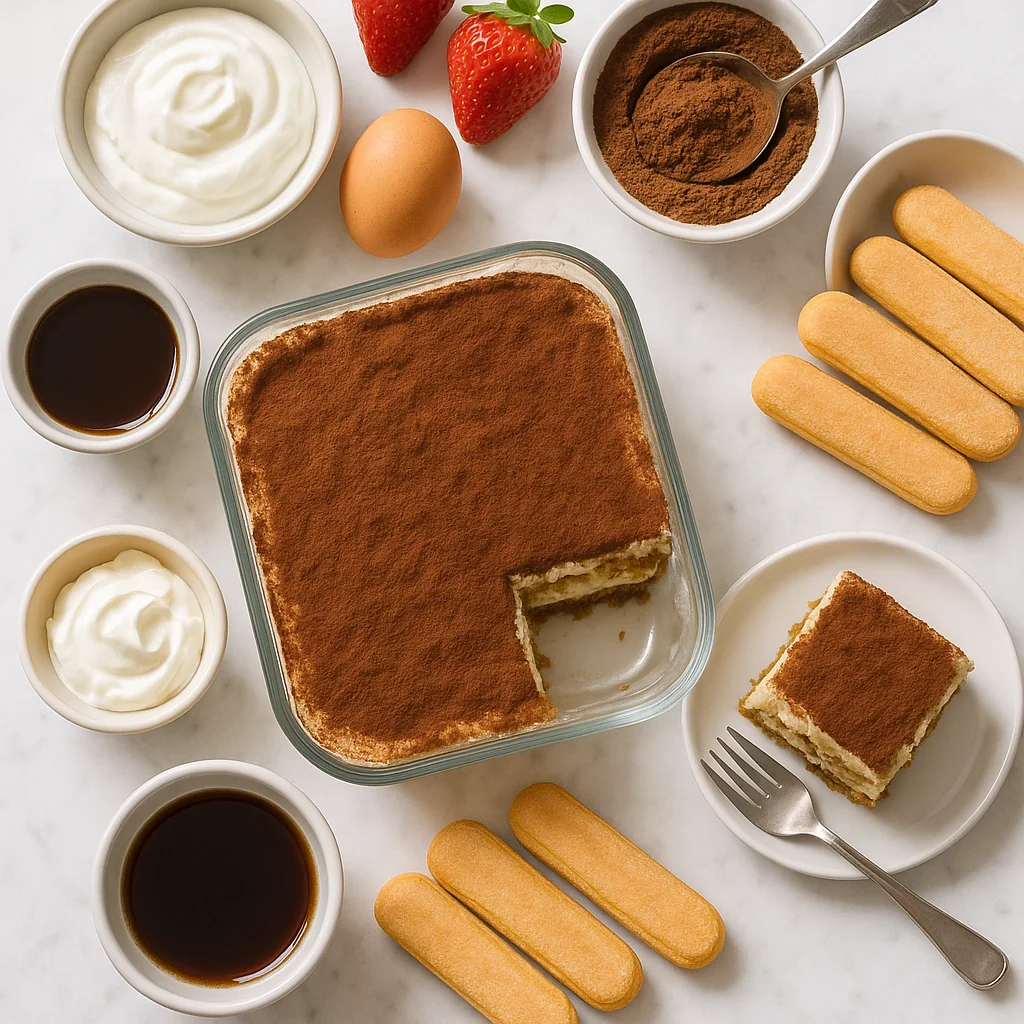
Italian Sfogliatelle Ricotta Dairy Free with Flaky Shells with Cashew Cream Filling
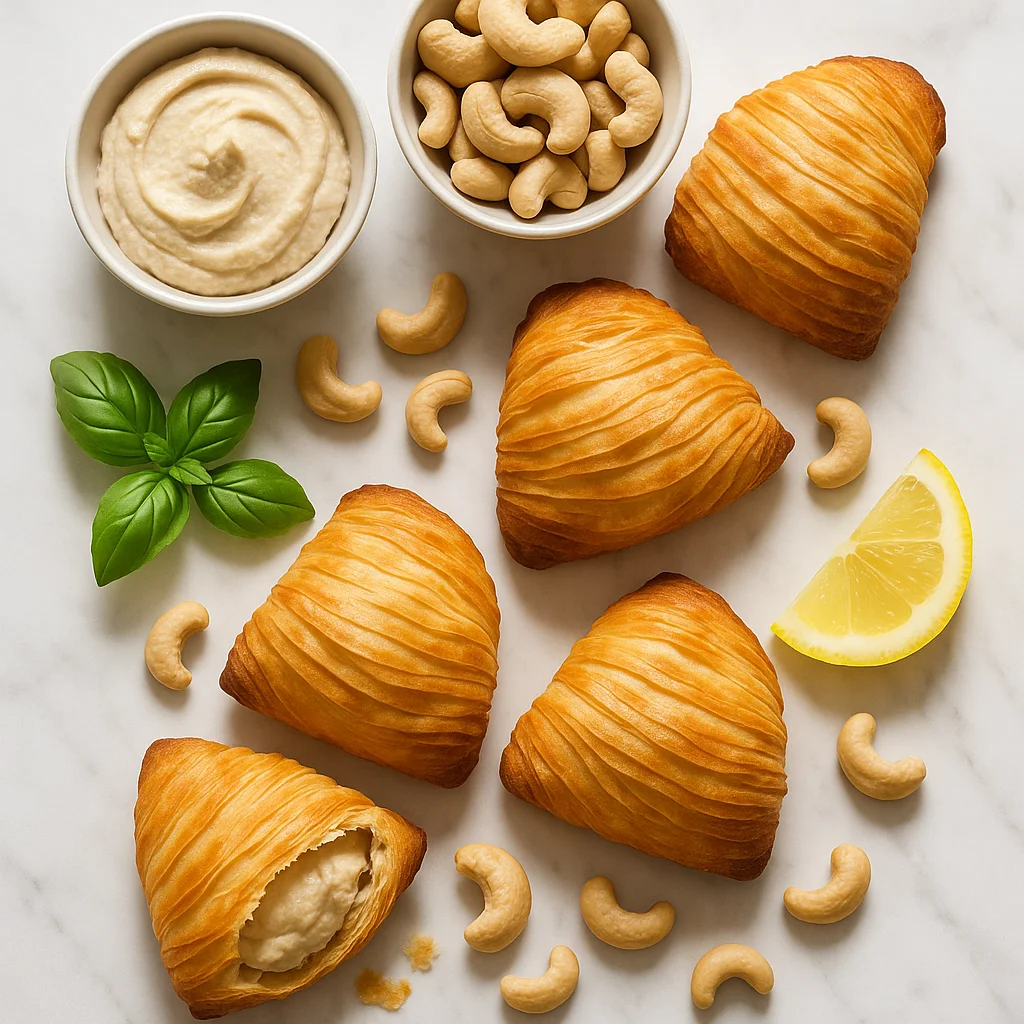
Sfogliatelle are one of the most technically demanding pastries in Italian confectionery, which is saying something in a tradition that includes cannoli, cassata and tiramisu. The shells are made by stretching a laminated dough into paper-thin sheets, rolling them into a tight log, slicing rounds from the log and then opening each round to create the shell shape. Each shell contains dozens of paper-thin layers that shatter dramatically when you bite through them. The filling is a sweetened ricotta mixture fragrant with cinnamon and candied citrus peel. This version uses a cashew cream filling in place of ricotta, making it fully dairy-free, and achieves a similar flakiness through the lamination of the shell without compromising on the essential sfogliatelle experience.
Why this recipe works
The lamination of the dough, the repeated rolling and folding that creates the layers, is what produces the shatteringly crisp shell. A dough made from semolina, plain flour and water, rested and then repeatedly worked with lard or coconut oil between each fold, develops hundreds of distinct layers that separate during baking as the fat between them melts. Cashew cream, made from soaked and blended raw cashews, has a neutral flavour and a creamy texture that takes seasoning well. Combined with a small amount of coconut sugar, cinnamon and orange zest, it provides a filling that is fragrant and complex without being heavy.
Getting it right
The dough must be rested thoroughly between each lamination stage. Skipping the rest periods causes the gluten to tear rather than stretch when you try to roll the next layer. Plan the lamination process over two to three hours, or refrigerate overnight between stages.
The shell shape is achieved by pressing your thumb into the centre of each dough round and working outward to open the layers. This takes practice. Expect the first two or three to look imperfect.
Common mistakes
Not soaking the cashews long enough before blending produces a grainy, coarse filling rather than a smooth, creamy one. Soak in cold water for at least four hours, or in warm water for thirty minutes.
Filling the shells too generously means the filling oozes out during baking and burns on the tray. A modest amount of filling per shell is correct.
Substitutions
Traditional ricotta mixed with egg yolk, sugar and cinnamon replaces the cashew cream for the authentic dairy version. Almond flour pastry can approximate the shell for a gluten-free adaptation, though the texture will be less flaky.
Serving suggestion
Serve warm, dusted with icing sugar. Sfogliatelle are at their best within thirty minutes of baking when the shells are at their crispest. A cup of strong Neapolitan espresso alongside is the correct pairing.
Ingredients
- 300 g white spelt flour (plus extra for dusting; all-purpose flour works equally well if spelt is unavailable)
- 50 g fine semolina (for the dough; gives the shell its characteristic colour and slight bite)
- 1 tsp fine sea salt
- 130 ml warm water (approximately — add gradually; the dough should feel stiffer than bread dough)
- 80 g refined coconut oil (solid but slightly softened, for laminating; must be refined (not virgin) to avoid coconut flavour)
- 200 g raw cashews (soaked in cold water for 12 hours or overnight, then drained and rinsed thoroughly)
- 120 ml unsweetened oat milk (or other plain unsweetened plant milk; soy milk gives the creamiest result)
- 60 g fine semolina (for the filling; this is what thickens the cashew cream into a ricotta-like consistency)
- 240 ml water (for cooking the semolina filling; use filtered water for the cleanest flavour)
- 3 tbsp pure maple syrup (grade A, amber; agave nectar or coconut nectar can substitute 1-to-1)
- 1 large orange (zest only, unwaxed; the zest is essential — do not substitute with orange extract)
- 1 tsp ground cinnamon (Ceylon cinnamon preferred for its more delicate, floral flavour compared to cassia)
- 0.3 tsp vanilla powder (or 1 tsp pure vanilla extract; vanilla powder gives a cleaner flavour without added liquid)
- 1 pinch fine sea salt (for the filling; salt amplifies the orange and cinnamon and balances the sweetness)
- 1 tbsp powdered erythritol or coconut sugar (for dusting before serving; powdered erythritol gives a snow-white finish, coconut sugar adds a caramel note)
Instructions
- 1
Make the dough: Combine the spelt flour, fine semolina, and salt in a large mixing bowl. Add the warm water a little at a time, mixing with your hands or a dough scraper until a stiff, non-sticky dough forms. You may not need all the water. Knead firmly for 8 to 10 minutes until smooth and elastic.
The dough should feel noticeably stiffer than bread dough — almost like firm Play-Doh. This stiffness is absolutely essential for achieving paper-thin, non-tearing layers during the rolling stage.
- 2
Divide the dough into 4 equal pieces. Flatten each piece into a rectangle, wrap tightly in cling film, and rest at room temperature for 30 minutes. This relaxes the gluten and makes rolling much easier.
Do not skip or shorten this rest — gluten that has not relaxed will spring back constantly as you try to roll, making it nearly impossible to achieve the thinness required. 30 minutes is the minimum; 45 minutes is even better.
- 3
Set your pasta machine to its widest setting. Working one piece of dough at a time (keep the rest wrapped), feed the dough through the machine repeatedly, folding and rotating between passes, until it is silky smooth. Then gradually work through to the thinnest setting, ending up with a long, almost translucent sheet. Lay on a lightly floured surface.
If you do not have a pasta machine, use a long rolling pin and work in sections. Roll away from you using firm, even pressure, then rotate the dough 90 degrees and repeat. You are aiming for 1 to 2 mm — thin enough that you can just see your hand through the dough when held up to the light.
- 4
Brush the entire surface of the dough sheet very lightly with softened coconut oil. Starting from one short end, roll the dough up tightly into a compact log. Set aside on a lightly floured tray and repeat with the remaining three pieces of dough. Once all four logs are made, press them together end to end and continue rolling the combined log until it is uniform in diameter — about 5 cm across. Wrap in cling film and refrigerate for at least 90 minutes, or overnight.
The tighter you roll, the more distinct and beautiful the spiral layers will be in the finished pastry. Use the palm of your hand to keep even, firm pressure as you roll. If the coconut oil starts melting from the warmth of your hands, briefly chill the dough sheet for 5 minutes before continuing.
- 5
While the dough chills, make the cashew cream filling. Drain and rinse the soaked cashews thoroughly. Place them in a high-speed blender with the oat milk and blend until completely smooth and thick, scraping down the sides as needed. Transfer to a medium saucepan.
Blend for at least 2 full minutes at high speed to achieve the smoothest possible texture — any remaining graininess at this stage will remain in the baked filling. If your blender struggles, add an extra tablespoon of oat milk to help it along, then cook the filling for a minute longer to compensate for the extra liquid.
- 6
Add the water and fine semolina to the saucepan with the cashew cream. Place over medium-low heat and cook, stirring constantly with a silicone spatula, for 6 to 8 minutes until the mixture thickens into a stiff paste that pulls away from the sides of the pan. Remove from heat.
Keep stirring continuously and do not leave the pan unattended — cashew-semolina mixtures scorch very quickly on the base of the pan once they start to thicken. Use a silicone spatula to scrape right into the corners of the pan with every stroke.
- 7
Stir the maple syrup, orange zest, cinnamon, vanilla, and salt into the hot semolina-cashew mixture until fully combined. Transfer to a bowl, press a sheet of cling film directly onto the surface to prevent a skin forming, and refrigerate until completely cold — at least 30 minutes.
Cold filling holds its shape dramatically better when you spoon it into the pastry shells. If you try to fill warm or even room-temperature shells, the filling will be too soft and may leak during baking. For best results, refrigerate for a full hour — or make the filling the day before and chill overnight.
- 8
Preheat your oven to 210°C (190°C fan / 415°F / Gas 7). Line two large baking sheets with baking parchment.
- 9
Remove the chilled dough log from the refrigerator. Using a sharp knife, slice the log into rounds approximately 1.5 cm thick. You should get around 14 rounds. Working with one round at a time, use your thumbs to press into the centre of the spiral and gently work it outward, rotating as you go, to open it into a small cone shape — the layers should fan open like a shell. Be gentle but firm; the cold dough may resist at first but will become pliable as it warms slightly.
If the dough cracks or resists opening, it is too cold — let the sliced round sit on the work surface for 2 to 3 minutes before trying again. If it tears easily and feels greasy, it is too warm — return it to the fridge for 10 minutes. The ideal working temperature is just slightly above fridge temperature.
- 10
Spoon approximately 1.5 tablespoons of the chilled cashew-semolina filling into each cone, pressing gently to fill without overfilling. Pinch the open edge together firmly to seal. Place sealed-side down on the prepared baking sheets, spaced 4 cm apart.
Ensure the edges are sealed firmly — use a small amount of water on your fingertips to help the dough edges stick if they feel dry. Any gaps in the seal will allow the filling to bubble and ooze out during baking, which affects both appearance and texture.
- 11
Bake for 22 to 25 minutes until the pastries are deeply golden, the layers have separated and puffed, and the shells feel crisp when tapped. Rotate the trays halfway through baking for even colour.
Do not open the oven door in the first 15 minutes of baking — the burst of steam from the filling helps the layers separate and puff dramatically. Resist the urge to check until the 15-minute mark. A deeply golden colour is what you want; pale pastry will be soft rather than crisp.
- 12
Remove from the oven and allow to cool on the trays for 5 minutes. Dust generously with powdered erythritol or coconut sugar and serve warm.
Sfogliatelle are at their absolute best eaten within 30 to 45 minutes of coming out of the oven — the shell is at its crispest and the filling is perfectly set but still slightly warm. If you must serve later, a 5-minute blast in a hot oven will restore much of the crispness.
Nutrition per serving
198kcal
Calories
5.2g
Protein
24.1g
Carbs
9.4g
Fat
2.8g
Fibre
4.6g
Sugar
112mg
Sodium
Pro Tips
- ✓
Soak the cashews for a full 12 hours in cold water if possible, longer soaking breaks down the cell structure more completely, yielding a silkier, creamier filling with no raw or bitter aftertaste. If you are short on time, cover with boiling water and soak for 1 hour as a quick alternative.
- ✓
Keep the dough log very cold right up until you slice it, a firm, well-chilled log is dramatically easier to cut cleanly with a sharp knife without squashing or distorting the layers. If the log softens while you are shaping, return it to the fridge for 10 minutes.
- ✓
Refined coconut oil is essential here; virgin or extra-virgin coconut oil has too strong a coconut flavour that directly competes with the delicate orange and cinnamon notes of the filling. Refined coconut oil is flavour-neutral and behaves just like lard in terms of texture.
- ✓
A pasta machine makes this recipe dramatically easier and produces far thinner, more even layers than a rolling pin alone. If using a rolling pin, work in very small sections of dough and use the weight of the pin, not muscle force, to achieve even pressure across the sheet.
- ✓
Work in a cool kitchen if at all possible, warmth softens the coconut oil too quickly during the laminating stage, causing the layers to fuse together rather than staying separate and distinct. If your kitchen is warm, refrigerate the dough log for an extra 30 minutes before slicing.
- ✓
These pastries are at their absolute best eaten warm within 30 to 45 minutes of coming out of the oven when the shell is at its crispest. Leftovers can be re-crisped in a preheated 200°C oven for 5 to 6 minutes the next day, avoid the microwave, which will make the shell soft and chewy rather than crisp.
Frequently Asked Questions
Variations
- •
Chocolate Orange Dairy Free Sfogliatelle
Stir 2 tablespoons of raw cacao powder into the cashew-semolina filling along with the orange zest for a rich chocolate-citrus flavour. Dust the finished pastries with a mixture of cacao powder and powdered erythritol.
- •
Lemon and Cardamom Filling
Replace the orange zest with lemon zest and swap the cinnamon for half a teaspoon of ground cardamom. The result is lighter and more floral, wonderful in spring and summer.
- •
Pistachio Cream Sfogliatelle
Replace half the cashews with raw unsalted pistachios for a vivid green, nutty filling. Fold in a tablespoon of chopped pistachios after cooking for extra texture. The green filling is visually stunning against the golden shell.
- •
Gluten Free Sfogliatelle
Replace the spelt flour with a 1-to-1 gluten free bread flour blend, look for one that includes xanthan gum. The dough will be slightly less stretchy and the layers slightly less dramatic, but the flavour remains excellent.
Substitutions
- •White spelt flour → Plain all-purpose flour (All-purpose flour works very well and is more traditional, the dough will be slightly more elastic and easier to stretch thin. You will lose a small amount of fibre compared to spelt.)
- •Refined coconut oil → Vegan butter (solid, block-style) (A solid vegan butter like Naturli or Flora Plant Butter will work for laminating. The flavour will be slightly richer and more buttery, which many people enjoy.)
- •Raw cashews → Raw macadamia nuts (Macadamias produce an equally smooth and creamy result with a slightly more buttery flavour. Soak them for the same length of time as cashews.)
- •Pure maple syrup → Agave nectar or coconut nectar (Both work well as a 1-to-1 swap. Agave is slightly more neutral in flavour; coconut nectar is darker and has a mild caramel note that works beautifully with the cinnamon.)
- •Oat milk → Almond milk, soy milk, or rice milk (Any unsweetened plain plant milk works here. Soy milk produces the creamiest result; rice milk the most neutral flavour.)
🧊 Storage
Sfogliatelle are best eaten on the day they are baked, ideally within an hour of coming out of the oven. If you have leftovers, store them uncovered at room temperature for up to one day, storing in an airtight container traps steam and softens the shell. Re-crisp in a preheated 200°C oven for 5 minutes before serving. Do not refrigerate, as this will make the pastry soft.
📅 Make Ahead
The dough log can be prepared up to two days in advance and kept wrapped in cling film in the refrigerator. The cashew-semolina filling can also be made up to two days ahead and refrigerated in a covered bowl. On baking day, simply slice, shape, fill, and bake, making this a much more manageable project when split across two days.
More Italian Desserts Recipes
Italian Almond Biscotti Gluten Free with Crispy, Low-Sugar Classic
Italian Panna Cotta Low Calorie with Creamy Vanilla Dessert Under 120 Calories
Dairy Free Espresso Affogato Recipe with Coconut Banana Nice Cream