Vegan Mango Coconut Milk Panna Cotta with Fresh Mango Coulis
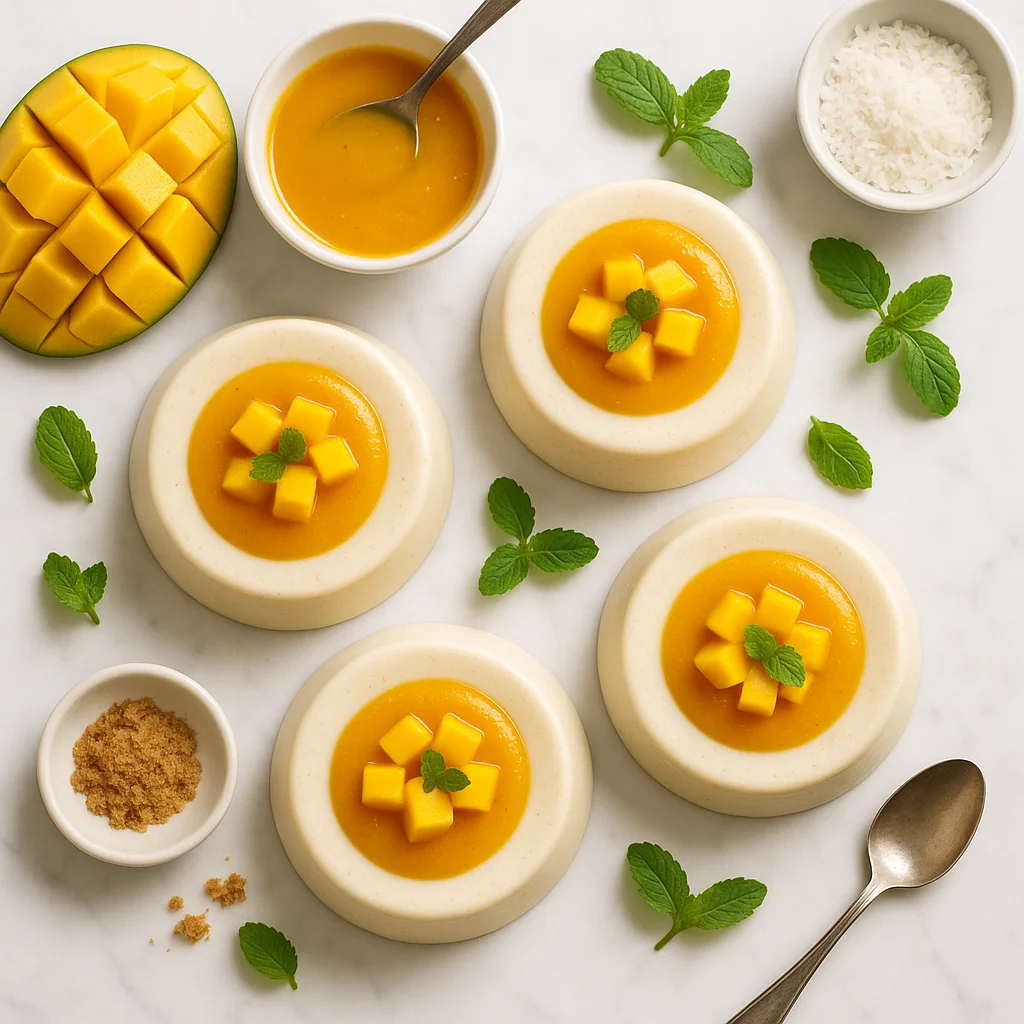
If you have ever dreamed of a dessert that feels indulgent but leaves you feeling genuinely good, this vegan mango coconut milk panna cotta is exactly what you have been looking for. Silky smooth, vibrantly golden, and bursting with the kind of tropical sweetness that instantly transports you somewhere warm and sunny, this recipe is proof that healthy desserts do not have to compromise on flavour or texture. Traditional panna cotta is made with heavy cream, full-fat dairy, and generous amounts of refined white sugar.
This version flips that formula entirely. By using light coconut milk as the base and sweetening the dessert with pure maple syrup, we keep the calories lower, eliminate all dairy, and make every single ingredient one you can feel proud of. The result is a luscious, wobble-perfect panna cotta that just happens to be completely plant-based.
The real star of this recipe is the mango. We use fresh or frozen ripe mango in two ways: blended directly into the panna cotta mixture for a gorgeous golden hue and natural fruity depth, and then again as a simple three-ingredient mango coulis spooned over the top just before serving. Mango is a genuinely nutritious fruit, offering vitamin C, vitamin A in the form of beta-carotene, and a useful amount of dietary fibre, particularly when you keep the flesh rather than juicing it.
That means each serving of this dessert delivers more nutritional value than the traditional cream-based version while still satisfying even the most devoted sweet tooth. The setting agent in this recipe is agar-agar powder, a plant-derived alternative to gelatin that is made from seaweed. It works beautifully here and sets reliably, making this panna cotta 100 percent vegan and suitable for vegetarians too.
Agar-agar does set slightly firmer than gelatin, so we have calibrated the quantity carefully to give you that signature gentle wobble rather than a rubbery result. Getting the ratio right is one of the most important tips we will share, and you will find full guidance in the tips section below. One important thing to understand about agar-agar versus gelatin is timing.
Agar-agar begins to set at around 40°C, far faster than gelatin, so once your mixture is off the heat, you need to move efficiently. Have your moulds or glasses ready and waiting before you even start cooking, and pour the mixture while it is still warm and fully fluid. Working quickly ensures a smooth, even texture in every mould without any partially set lumps.
The mango you choose matters just as much as the technique. For the very best flavour, look for Alphonso or Ataulfo mangoes when they are in season, both varieties are intensely sweet, deeply fragrant, and produce a gloriously golden puree with minimal fibre. Kesar mangoes are another excellent choice.
If fresh mangoes are unavailable, good-quality canned Alphonso mango puree is a brilliant substitute and in some ways even more reliable, as the sweetness and consistency are uniform from tin to tin. Just check the label for added sugar and reduce the maple syrup in the recipe accordingly. One of the things that makes this recipe genuinely special for health-conscious bakers is how flexible it is.
You can adjust the sweetness up or down based on the ripeness of your mango, layer the panna cotta into glasses for beautiful no-fuss presentation without any unmoulding required, or add warming spices like cardamom and turmeric to the base for a fragrant Indian-inspired twist. It works brilliantly as a dinner party dessert because it must be made ahead and chilled for at least four hours, which means your fridge does all the work while you relax. With only around 165 calories per serving, less than 10 grams of added sugar per portion, and a solid hit of fibre from the mango flesh, this dessert genuinely earns its place in a healthy eating plan.
Whether you are dairy-free by choice or necessity, following a plant-based lifestyle, or simply trying to find lighter alternatives to your favourite classic desserts, this vegan mango coconut milk panna cotta deserves a permanent spot in your recipe collection. It is gluten-free, egg-free, refined sugar-free, and requires no baking whatsoever. It is also one of those recipes that looks far more impressive than the effort involved, which is always a welcome quality in a dessert.
Serve it unmoulded onto a plate with a generous drizzle of mango coulis and a few toasted coconut flakes scattered over the top for texture, or keep it casual in pretty glasses topped with diced fresh mango and a sprig of fresh mint. For an extra special touch, try lightly grilling or pan-caramelising a few thick mango slices in a little coconut oil and a sprinkle of coconut sugar, then arranging them alongside the panna cotta, the gentle caramelisation adds a beautiful depth of flavour that elevates the whole dessert to dinner-party-worthy territory. Either way, every spoonful is a reminder that eating well and eating beautifully are not mutually exclusive goals.
Ingredients
- 400 ml light coconut milk (one standard tin, well shaken before opening; light coconut milk keeps calories lower while still delivering creaminess)
- 200 ml unsweetened coconut milk from carton (the thinner drinking variety, not tinned — this thins the mixture to the right consistency for a gentle wobble rather than a firm set)
- 200 g fresh or frozen ripe mango flesh (from approximately 1 large mango, thawed and drained if frozen; Alphonso, Ataulfo, or Kesar varieties give the best flavour and colour)
- 3 tbsp pure maple syrup (adjust to taste based on mango sweetness — very ripe or canned mango may need only 2 tablespoons)
- 1 tsp vanilla extract (pure, not imitation — rounds out the coconut and mango flavours beautifully)
- 1 tsp agar-agar powder (not flakes — powder is far more concentrated and reliable; agar-agar flakes would require approximately 1 tablespoon and even then can produce inconsistent results)
- 1 pinch fine sea salt (a small pinch of salt sharpens and lifts all the other flavours — do not skip it)
- 150 g fresh ripe mango flesh (for the coulis, roughly chopped; can substitute with good-quality canned mango — check for added sugar and adjust maple syrup accordingly)
- 1 tbsp maple syrup (for the coulis — taste before adding as ripe mango may need none at all)
- 1 tbsp fresh lime juice (for the coulis, approximately half a lime — the acidity balances the sweetness and brightens the tropical flavour)
- 2 tbsp toasted coconut flakes (to garnish, optional — adds a pleasant crunch and visual contrast against the smooth panna cotta)
- 4 sprigs fresh mint (to garnish, optional — adds colour and a fresh herbal note that cuts through the richness)
Instructions
- 1
Place the fresh or frozen mango flesh (200g) into a blender and blitz until completely smooth. Set the mango puree aside.
If using frozen mango, ensure it is fully thawed and drained of excess liquid before blending. Excess water will dilute the panna cotta and may affect the set. Pat the flesh dry with kitchen paper if it seems very wet.
- 2
Lightly grease four small ramekins or pudding moulds (approximately 150ml capacity each) with a tiny amount of coconut oil, or set out four small glasses or cups if you prefer to serve the panna cotta directly in the vessel without unmoulding.
Using glasses makes this even easier and the layered golden colour looks stunning through clear glass. It also completely eliminates the stress of unmoulding. For a dinner party, individual glass tumblers or champagne flutes look particularly elegant.
- 3
Pour the light tinned coconut milk and the carton coconut milk into a medium saucepan. Whisk in the agar-agar powder until no lumps remain. Allow to sit for two minutes to begin dissolving.
Never skip the whisking step — undissolved agar-agar clumps will create uneven setting and a grainy texture. If you notice any stubborn lumps, use the back of a spoon to press them against the side of the pan before heating.
- 4
Place the saucepan over medium heat and bring the mixture to a gentle simmer, stirring frequently. Once it reaches a simmer, continue cooking for exactly two minutes, stirring constantly. This step is essential to activate the agar-agar fully.
Do not allow the mixture to boil vigorously as this can affect the final texture and cause the coconut milk to separate. A gentle, steady simmer with constant stirring is all you need. Set a timer for two minutes once it reaches a simmer — agar-agar is unforgiving if undercooked.
- 5
Remove the saucepan from the heat. Stir in the blended mango puree, maple syrup, vanilla extract, and sea salt. Whisk everything together until completely smooth and well combined.
Taste the mixture at this point and adjust sweetness if needed. Remember that flavours will taste slightly muted once chilled, so the mixture should taste just a touch sweeter than you want the final result to be. If your mango was very ripe and sweet, you may not need all three tablespoons of maple syrup.
- 6
Carefully pour the mixture through a fine mesh sieve into a jug, then divide evenly between the four prepared ramekins or glasses. This straining step ensures a perfectly smooth, silky panna cotta.
Work quickly once the mixture is off the heat — agar-agar begins setting at around 40°C, which is much faster than gelatin. Have your moulds or glasses positioned and ready before you start pouring. The sieve also catches any fibrous mango strands, ensuring a perfectly silky texture.
- 7
Allow the panna cottas to cool at room temperature for 15 minutes, then transfer to the refrigerator. Chill for a minimum of 4 hours, or ideally overnight, until fully set.
Do not rush this step by placing warm panna cottas directly into a very cold fridge — allow them to come to room temperature first so condensation does not form on the surface. Cover loosely with cling film once at room temperature.
- 8
While the panna cottas chill, make the mango coulis. Blend the remaining 150g of mango flesh with 1 tablespoon maple syrup and the lime juice until smooth. Taste and adjust sweetness or acidity. Transfer to a small jug or bowl, cover, and refrigerate until ready to serve.
For a perfectly smooth coulis, pass it through a fine sieve after blending to remove any fibrous mango strands. If the coulis is too thick, thin it with a teaspoon of water or extra lime juice. It should flow easily from a spoon.
- 9
To unmould, run a thin knife around the edge of each ramekin and invert onto a serving plate with a sharp, confident tap. If the panna cotta does not release, gently press the edges inward and try again.
If serving in glasses, skip this step entirely and simply spoon the coulis directly over the top. If a panna cotta refuses to release, dip the base of the ramekin briefly in a bowl of warm (not hot) water for 5 seconds — this gently loosens the edges without melting the set.
- 10
Spoon the mango coulis generously around and over each panna cotta. Scatter with toasted coconut flakes and garnish with a sprig of fresh mint. Serve immediately.
For an elevated presentation, lightly pan-fry a few extra mango slices in a tiny amount of coconut oil with a pinch of coconut sugar for 1–2 minutes per side to caramelise them. Arrange alongside the panna cotta for a restaurant-quality finish.
Nutrition per serving
165kcal
Calories
1.8g
Protein
22g
Carbs
8.5g
Fat
1.8g
Fibre
18g
Sugar
55mg
Sodium
Pro Tips
- ✓
Always use agar-agar powder rather than flakes for this recipe, flakes are far less concentrated and the conversion is unreliable. As a general guide, 1 teaspoon of agar-agar powder is equivalent to roughly 1 tablespoon of agar-agar flakes, but even with that conversion the setting consistency can vary significantly between brands.
- ✓
Agar-agar must reach a full, steady simmer and be cooked for at least two minutes to activate its setting properties. Set a timer once the mixture begins to simmer, undercooked agar-agar will result in a soft, poorly set dessert that will not hold its shape when unmoulded.
- ✓
The variety and ripeness of your mango makes an enormous difference to the final flavour. Alphonso, Ataulfo, and Kesar mangoes are the gold standard, deeply sweet, intensely fragrant, and virtually fibre-free. If fresh mangoes are out of season, high-quality canned Alphonso mango puree is an excellent and consistent alternative. Always taste before adding maple syrup if using canned mango, as it is often sweetened.
- ✓
Agar-agar sets at around 40°C, much faster than gelatin, so speed matters once the mixture is off the heat. Have your moulds or glasses greased and positioned before you begin cooking, and pour the mixture while it is still warm and fully fluid. This prevents uneven textures from the mixture beginning to set in the pan.
- ✓
For the cleanest unmoulding, lightly coat the inside of each ramekin with a thin layer of neutral-tasting oil before filling, and ensure the panna cotta is completely and firmly set before attempting to turn it out. If it resists, briefly dip the base of the ramekin in warm water for 5 seconds to loosen the edges without melting the dessert.
- ✓
If you prefer a richer, more indulgent result closer to a traditional panna cotta, replace the carton coconut milk with a second tin of full-fat coconut milk. This increases the creaminess and fat content significantly but produces an exceptionally luxurious texture. Alternatively, serving in glasses rather than unmoulding removes any anxiety about the set and lets you dial back the agar-agar very slightly for an even softer, more delicate wobble.
Frequently Asked Questions
Variations
- •
Layered Mango and Coconut Panna Cotta
Make two separate batches, one plain coconut panna cotta (without mango) and one full mango version. Pour the coconut layer first, allow to set for 30 minutes in the fridge until just firm, then carefully pour the mango layer on top for a stunning two-tone effect.
- •
Passion Fruit and Mango Panna Cotta
Replace 50g of the blended mango with the strained juice of 3 passion fruits for a sharper, more tangy tropical flavour. Top with fresh passion fruit pulp and seeds instead of coulis for beautiful presentation.
- •
Spiced Mango Coconut Panna Cotta
Add half a teaspoon of ground cardamom and a small pinch of ground turmeric to the coconut milk mixture before heating. The cardamom adds a fragrant warmth and the turmeric deepens the golden colour beautifully.
- •
Lime and Mango Panna Cotta
Add the zest of one lime and an extra tablespoon of lime juice to the panna cotta mixture along with the mango. This brightens the flavour significantly and pairs wonderfully with the sweet mango and creamy coconut base.
Substitutions
- •Light coconut milk → Full-fat tinned coconut milk (Use full-fat for a richer, creamier texture. This will increase the calorie and fat content but produces a more luxurious result.)
- •Carton coconut milk → Almond milk or oat milk (Either works well as the thinner liquid component. Oat milk adds a subtle sweetness while almond milk keeps the flavour very neutral.)
- •Maple syrup → Agave nectar or coconut nectar (Both are suitable vegan alternatives with a similar sweetness level. Coconut nectar has a slightly caramel-like flavour that complements the tropical ingredients well.)
- •Agar-agar powder → Gelatin (non-vegan) (Use 2 teaspoons of powdered gelatin bloomed in cold water. This makes the recipe non-vegan but produces a slightly softer, more traditional wobble.)
- •Fresh mango → Frozen mango or tinned mango puree (Both work well. Thaw frozen mango completely and drain before blending. For tinned puree, use approximately 180ml and check for added sugars.)
🧊 Storage
Store set panna cottas covered with cling film or in an airtight container in the refrigerator for up to 3 days. Store the mango coulis separately in a sealed jar or container in the fridge for up to 3 days. Do not freeze.
📅 Make Ahead
This recipe is ideal for making ahead. Prepare the panna cottas up to 48 hours before serving and refrigerate until needed. Make the coulis the day before and store it separately. Assemble and garnish just before serving for the best presentation.
More Vegan Desserts Recipes
Vegan Banana Nice Cream
Vegan Chocolate Chia Pudding
Creamy Vegan Chocolate Avocado Mousse (5 Ingredients, No Refined Sugar)